

PURPLE HEARTS
Written by C.S Wallace
Directed by Nich Radcliffe
Michigan Tech University Visual Performing Arts Houghton, MI April 2024
Assistant Production Sound Engineer and A2
The responsibilities of the Assistant Production Sound Engineer were to attend production meetings with lead Production Sound Engineer to communicate with lighting, scenic, and Technical Director, attend meetings with system design team to work out any discrepancies with the sound system, gather equipment needed for front of house, stream booth, tech tables during tech rehearsal, and assist with leading work crew during load-in, shop-builds, and strike. The responsibilities of the A2/Wireless show crew were to test actor microphones with A1 at front of house prior to rehearsal and performances, modify appearance of said microphones to match the hair color of the actors/actresses, fix any wireless microphone problems that may occur during rehearsals/performances, and adjust position of actor mics to allow the best vocal sound.
In the first weeks of production, equipment such as cables and speakers required for the system were gathered, tested, and prepped for rigging. Upon testing the speakers, two of the speakers (B2 Subwoofers) were unable to be tested/used since the cables had incompatible connectors for the speaker’s amplifiers. Prior to load-in, I modified the cables by replacing the incompatible connectors with the correct ones, allowing us to use the speakers.


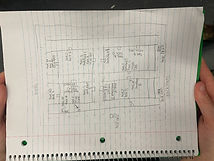
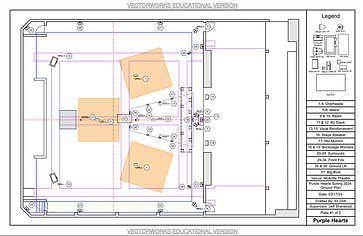
As part of the production process, I created a to-do list in Google Docs that allowed the sound team to keep an organized list of tasks they needed to complete. This allowed the sound teams to understand the state of the production in terms of sound. During shop-builds, I drafted the tielines in the upper catwalks of the theatre to make the patching process easier for the sound crew during load-in. Then I created an AutoCAD drawing that could be used for future reference.

Production Photos
Photos Courtesy of Lighting Designer
Terry Jachimiak


Upon load-in, the system was tuned and set to the desired level of 80dB, by utilizing a pair of microphones, a decibel meter, an acoustic measurement software Smaart, and a DSP named Audio Architect. The microphones were placed in the position of the audience where Audio architect then sent pink noise through the speakers the mic was pointing at. The reading from the mic was then measured by Smaart, which allowed us to process the speaker's signal, making the speaker's frequency response as flat as possible.


As part of the A2/Wireless crew, an issue that arose was the appearance of the microphones on the actors. Some actors cut their hair short, leading to the microphone being visible.
This posed a problem. To solve it, the Microphones were replaced with a different color or painted to match the color of the actor’s hair. For one actor, there was a scene where he poured fake blood onto his head. Instead of leaving his microphone on the top of his head, an earpiece microphone was created to reduce the risk of blood causing technical problems.


